WanascopeCompanion for WaniKani
Connect WaniKani

Coverage · JLPT, Jōyō, and frequency references

See where your passed WaniKani kanji already reach.

Compare passed kanji with clearly labeled JLPT N5–N1 reference groups, Jōyō groups, and a common-frequency reference, then open each group to inspect what is covered and what remains.

Connect read-only key
  • Explore with demo data
  • Read-only WaniKani access
  • API key and detailed study data are stored locally; Reader text stays in-page
  • Wanascope never asks for your WaniKani password
  1. Your passed-kanji overlap with the selected reference group.

  2. The exact passed and missing kanji, grouped by WaniKani level.

  3. A different lens for JLPT, Jōyō, and common-frequency references.

Coverage · inspect the actual kanji

Move from a level number to the kanji themselves.

A WaniKani level alone cannot describe personal coverage. Open a reference group, filter passed or missing items, and expand WaniKani-level clusters to see exactly which kanji produce the percentage.

  • Passed and missing filters for each group
  • Kanji clustered by WaniKani level
  • Personal results from reported passed dates
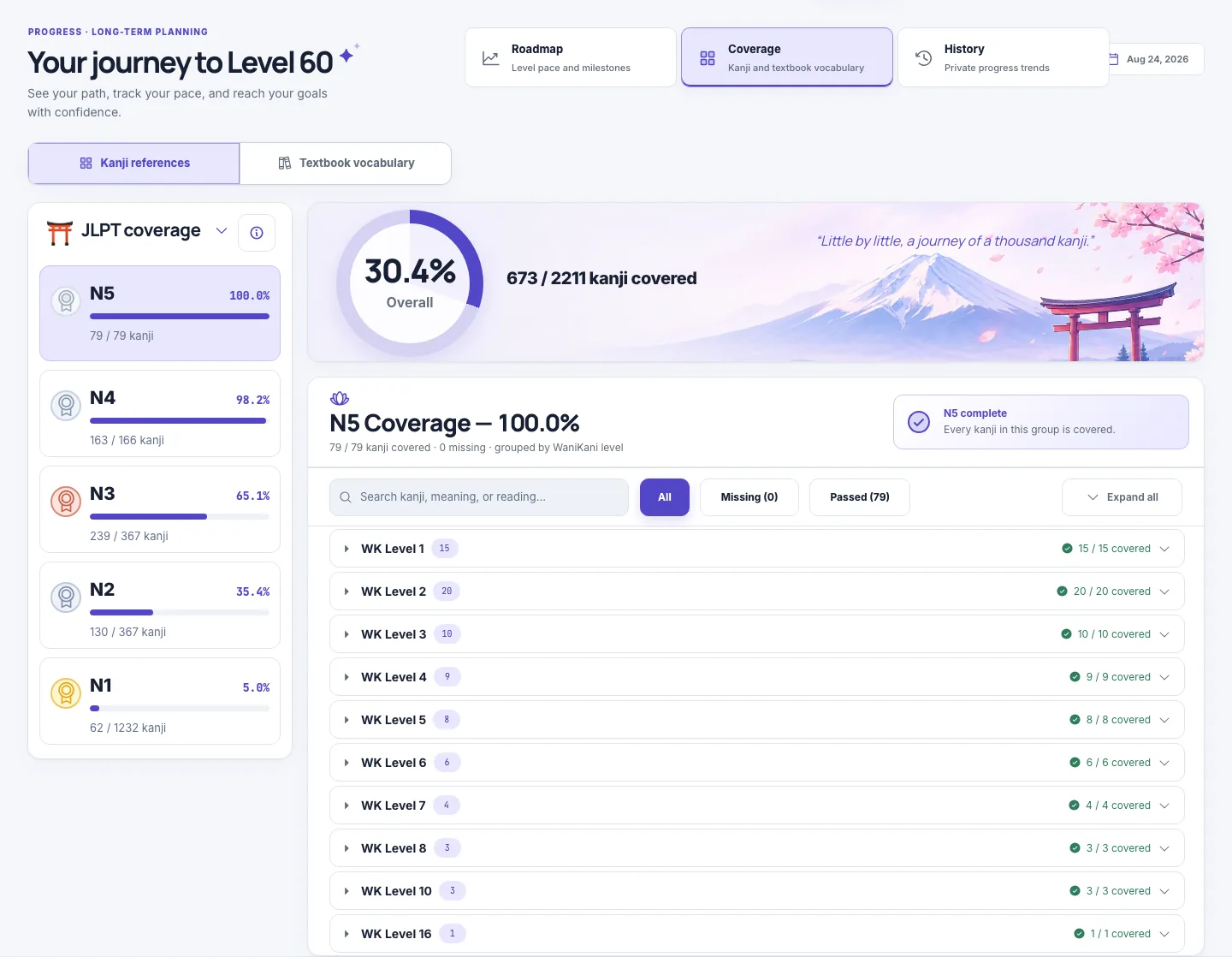
Wanascope Coverage with JLPT groups, overall overlap, filters, and expanded kanji grouped by WaniKani level.Demo data · every percentage leads back to inspectable kanji.
Reader · put coverage in context

Use passed kanji inside real Japanese text.

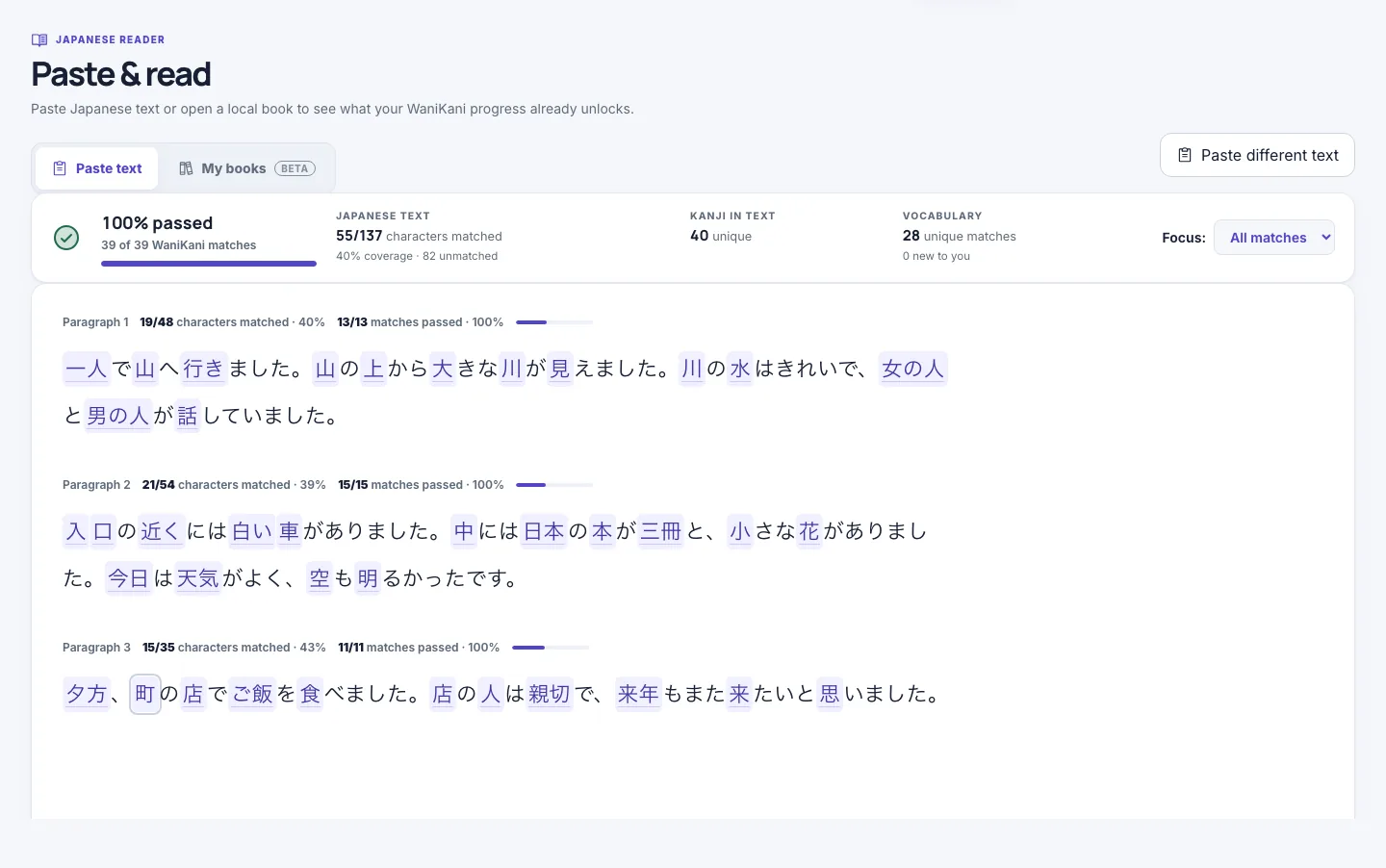
Reference overlap becomes more useful when it supports reading. Reader highlights WaniKani matches inside pasted Japanese, shows which matched items have passed, and keeps readings and meanings available without sending the text away.

  • Passed WaniKani matches highlighted in context
  • Kanji and vocabulary counts for the pasted text
  • Private in-browser analysis
Wanascope Reader showing matched Japanese text, passed WaniKani items, kanji counts, and vocabulary counts.Reader turns abstract coverage into visible Japanese you can already approach.

Progress · a broader view

Keep reference coverage beside your real study pace.

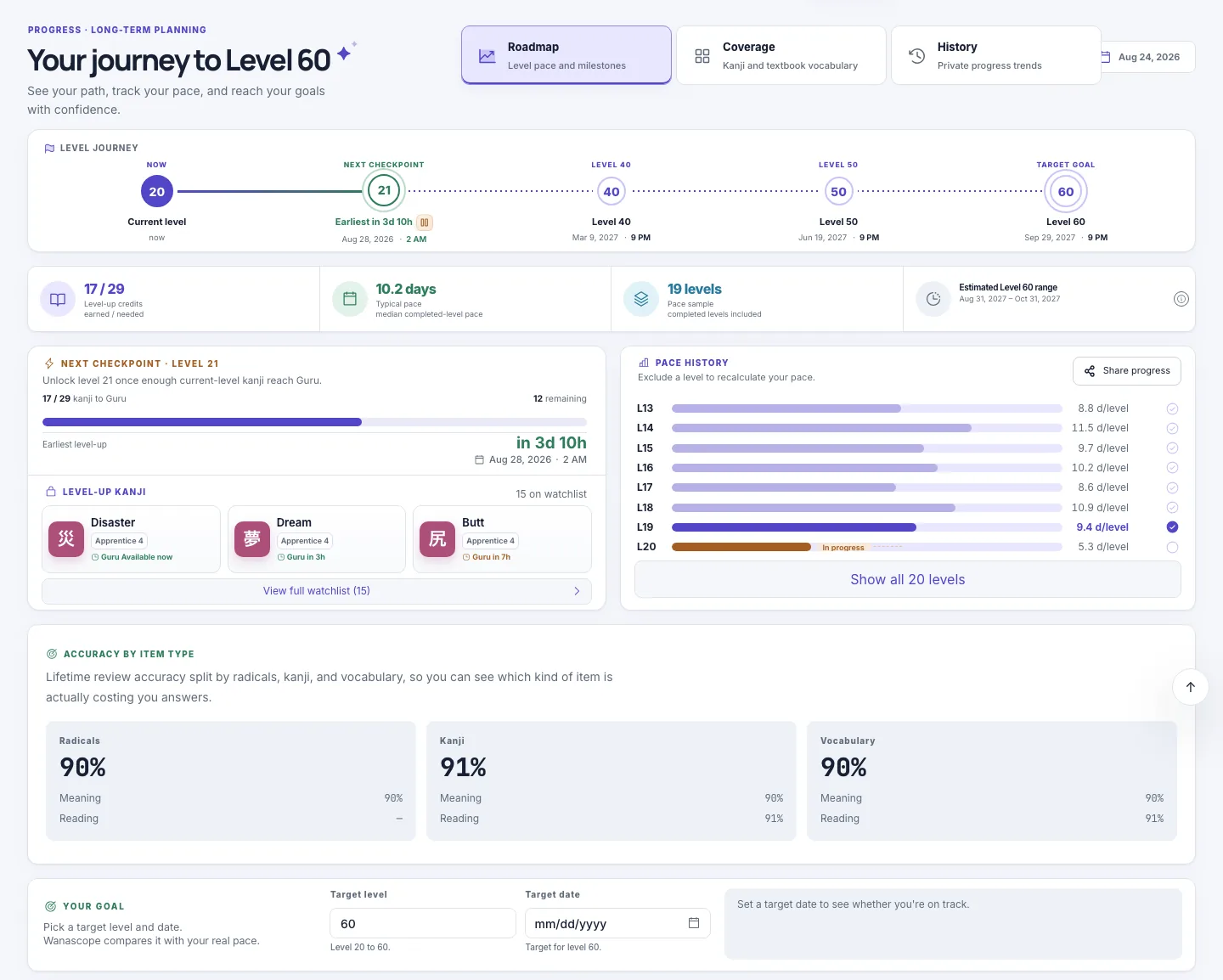
Coverage is one view inside Progress, alongside the Roadmap and private History. That placement keeps reference-list overlap connected to current level progress and completed-level pace instead of turning it into a standalone readiness score.

  • Roadmap, Coverage, and History as separate views
  • Current checkpoint beside broader references
  • No claim that coverage equals exam ability
Wanascope Progress with Roadmap, Coverage, and History navigation above the level journey.Progress keeps coverage as one lens, not the whole story.

WaniKani questions, answered clearly

What WaniKani level corresponds to JLPT N5, N4, N3, N2, or N1?

There is no official one-to-one conversion. The JLPT does not publish an official kanji list, WaniKani levels mix kanji from different references, and personal coverage depends on which kanji have passed. Wanascope therefore shows overlap with clearly labeled reference groups.

Does WaniKani cover every kanji in these JLPT references?

WaniKani and third-party JLPT references overlap but are not identical. Wanascope shows the passed and missing kanji inside each selected group so you can inspect the difference directly.

Does high kanji coverage mean I am ready for the JLPT?

No. Kanji overlap does not measure vocabulary, grammar, listening, recall, reading fluency, or exam technique. Use Coverage as a reference comparison, not an exam-readiness score.

Wanascope is an independent tool and is not affiliated with WaniKani or Tofugu. Lessons and reviews still happen on WaniKani.